
The exhibition “Everything That’s Interesting Is New” at the Factory of the Athens School of Fine Arts, in 1996, was groundbreaking. It was an unprecedented project for the Greek standards and many art meccas around the world could be easily jealous about it, with over a hundred internationally famous artists participating with their good works!
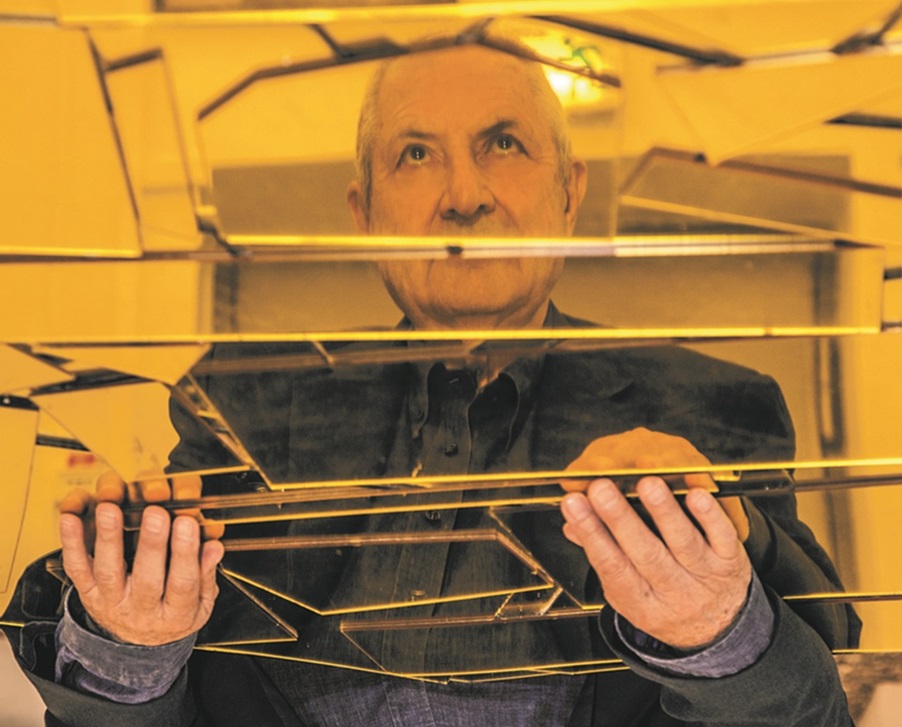
Among them was Martin Kippenberger, who had said: “I don’t consider this kind of exhibition as a ‘group’ one. It is more of a… one man show, of the collector.” Dakis Joannou grinned when I reminded him of it. “That’s right, I have no inhibitions about it.” Indeed, it is. The idiosyncratic and uncompromising DESTE Foundation, the institution that organized the show, is a cultural platform inextricably linked to the personality of Dakis Joannou.
This year marks 33 years of his nomadic activity. Even marking the anniversary could not be linked to a round number. “Why 33 years? This is a mystery… One can think of many things. Okay, let me give you a clue: the number can also be read upside down.” Dakis Joannou is not a man who babbles, he doesn’t talk pompously about himself, his collection or the work of DESTE. And it is absolutely clear that he stops those who attempt to do it in his place with more enthusiasm. In general, he is immune, as the English say, to flattery. “These things don’t pass,” he says and means it, sitting on a sofa in his home, which sometimes functions as a museum, surrounded by art that really delights the senses.
At first glance, he seems inaccessible, but, ultimately, behind the stern mound, he unleashes bursts of humor at his interlocutor completely without warning and creates a pleasant atmosphere. Either way, his name is a magnet for artists, curators, journalists, art enthusiasts and has appeared in headlines in the world’s largest newspapers, as well as on lists of the most powerful people in art worldwide. Inevitably, when he decided to get a Facebook profile a few years ago, he had over a thousand friend requests in about few minutes. “I couldn’t stay, I deleted my profile. That’s a way of saying, because you leave with great difficulty and your name always remains there.”
Deste foundation.
It is not particularly surprising that, in celebration of the unconventional anniversary, he “confesses” his personal history and the course of DESTE through a very exuberant publication of approximately 900 pages, entitled “DESTE: 33 YEARS”, edited by Karen Marta, Neil McClister and Eleni Michaelides. Nor that when he refers to the Foundation’s activities outside the book, he chooses to step out of the frame, or at least half-appears in it, because he wants to push the spotlight away from him to focus it on young Greek and Cypriot artists. Thirty-three of them – for each of DESTE’s thirty-three years -, with a maximum age limit of approximately 35 years, will present their work at the Benaki Museum from June 17. The charismatic “Equilibrists”, as the exhibition is titled, were selected by the curators of the New Museum in New York, Gary Carillon-Murayari and Helga Kristoffersen, following their personal research, as well as thanks to the suggestions of “more than twenty curators, artists and writers in Greece after their visits to Athens, Thessaloniki, Cyprus, London, Berlin”. The curatorship is headed by Massimiliano Gioni, artistic director of the New Museum, curator of the 55th Venice Biennale and an old acquaintance of Dakis Joannou. “Instead of looking to the past, DESTE looks forward and focuses on the future of new art in Greece.” Maybe just a few remember that the acronym DESTE that became known worldwide and was associated with the emergence of some of the most famous artists and curators in the world, such as Jeff Koons, Maurizio Cattelan or Massimiliano Gioni, does not simply mean “look” in Greek nor does it only refer to the exhortation “look at them”, a humorous comment on the open-mindedness, the madness if you will, of its founder and his collaborators. When Dakis Joannou founded DESTE in 1984 in collaboration with curators Adelina von Furstenberg and Efi Strouza, following the decisive guidance of the art critic and theoretical father of “New Realism”, Pierre Restany, he gave his project a clear international orientation, driven by the ambition “to present art within the context of its time”. However, DESTE, basically D.E.S.T.E. means International Greek Contemporary Art in Greek “It was Efi’s idea,” points out Dakis Joannou. Efi Strouza was also its first director, one of the two that the Foundation ever had. The second was the founding director of the Center for Contemporary Art in Psychiko, -a district in Athens, Katerina Gregou, from 1997 to 2002. With the exception of their “term”, DESTE remained and remains “headless” and without a specific program. “Everything just happens, there is no strategic planning,” says Dakis Joannou. “What I wanted was to develop exhibitions through an open dialogue with friends and collaborators.”
When Dakis met pop art and surrealism
Dakis Joannou’s contact with art was apparently fateful, while his genes prefigured his future cosmopolitanism. His father’s origin was from Lefkara, a small town with a tradition in the creation and trade of embroidery, whose residents traveled to Europe to sell their products, thus becoming carriers of a culture that transcended the narrow boundaries of the small, provincial municipality.
From his birthplace in Cyprus to the American College of Athens, where he graduated in 1958 – “my parents had heard some stories with EOKA, the National Organisation of Cypriot Fighters’ that fought a campaign for the end of British rule in Cyprus, and for eventual union with the rest of Greece and brought me to the Greek capital city” – to the USA, where he studied civil engineering at Cornell and Columbia, and in Rome, where he went in 1964 to supplement his academic knowledge with a doctorate in architecture, he sought art with his eye. “Picasso, for example, the easiest thing you could see through books in Cyprus”, then Klee and Van Gogh in Athens and then in New York live and in situ the froth of pop art artists “Johns, Warhol, Lichtenstein” and in Italy “De Chirico, Manchu, Marini, but not arte povera”
When he successfully completed his studies, his parents asked him what gift he would like to receive. “Of course, I wanted a De Chirico, but it would be a very expensive gift,” he would say. He finally asked for and received “Il grande bersaglio tricolore,” a work by Lucio del Pezzo that combined pop art with metaphysical painting. This is the first work that Dakis Joannou ever acquired, long before he even imagined that one day he would not only start a collection, but also become one of the greatest collectors of contemporary art in the world.
At the same time, he made his own attempt at creating a piece of art. It was a Coca-Cola bottle with a pipe stuck to it, an all-white sculpture where “pop art meets surrealism.” Few people knew about it, but in 2014, on the occasion of his 75th birthday, he commissioned the Swiss artist Urs Fischer to reproduce 500 copies of that original work to send to friends and colleagues “as a birthday present from the… opposite. I was playing, I never claimed to be an artist. I believe that an artist should dedicate his life to art. I’m not saying you can’t do it for fun and for your own enjoyment. But you can’t have demands afterwards.” He knew very well that he could not devote himself to art in this absolute way. In 1967, he returned to Cyprus to work in the family business, the construction company that his father had co-founded in 1941 as “Ioannou and Paraskevaides” in order to assist the British in building the appropriate infrastructure for the war operations of World War II – eventually one of the largest contracting companies in the Middle East, North Africa and Greece.
After the invasion of the Turkish military forces in Cyprus in 1974, he moved with his wife, Lieta, to London and a few years later, in 1980, he settled in Athens, where he has lived ever since. “We had no intention of staying in London permanently because of our children. We wanted them to grow up as Greeks, to have a Greek conscience. We saw the children of Greeks growing up in England and they were neither English nor Greek. Their grandchildren, however, were full-fledged English.”
Cultural geometry and the Greek artist.
With a Greek conscience, then, but an international horizon, Dakis Joannou founded DESTE a year after the exhibition “Emerging Images”. A show with works by Diochanti, Rena Papaspyrou and Giorgos Lazogas, among others at the Intercontinental Hotel, which had just been opened by the Joannou Family and partners company. Shortly after, Adelina von Furstenberg introduced him to the person who change his relationship with the art. The American gallerist and curator Jeffrey Deitch introduced him to the hot art scene of New York’s East Village, a neighborhood with about 60 galleries at the time. “I felt that there was a tremendous freshness there, a terrifying energy and that a new beginning was taking place. An explosion of creativity that resulted in an art that was related to everyday life, but had digested many older movements: minimalism, surrealism, dadaism, conceptualism.”
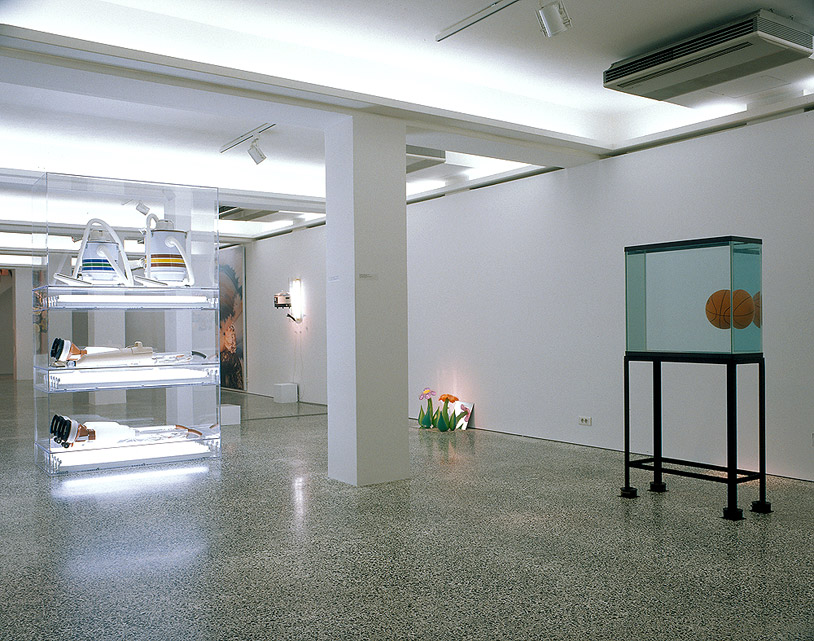
Among the galleries was “International with Monument”, where he saw the work that officially launched his collection. It was a basketball suspended in an aquarium, “One Ball Total Equilibrium Tank” by an artist named Jeff Koons. “I felt like I had seen a masterpiece, a powerful, primal image, an archetype.” It cost $3,000 and he bought it “at a 10% discount.” “Up until then, I had been buying works to hang on the wall. I thought collecting meant collecting trophies to hang above the sofa. I wasn’t interested in that at all. After that purchase and my acquaintance with Jeff and the other artists of the time, whose works I acquired, I discovered that I had a collection and that its definitely a creation and evolution that could be a creative process.”
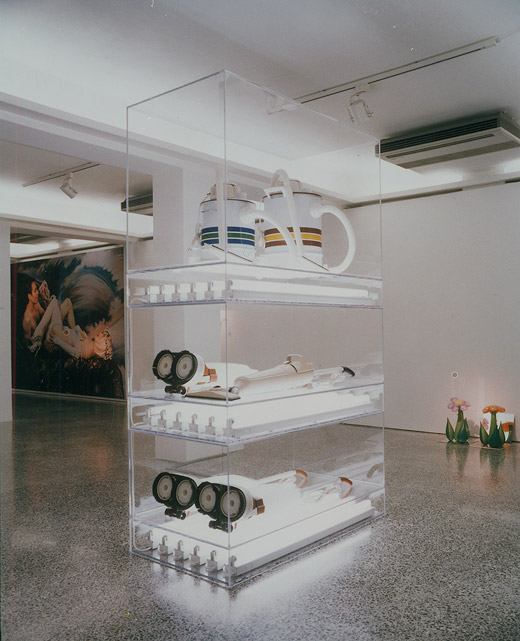
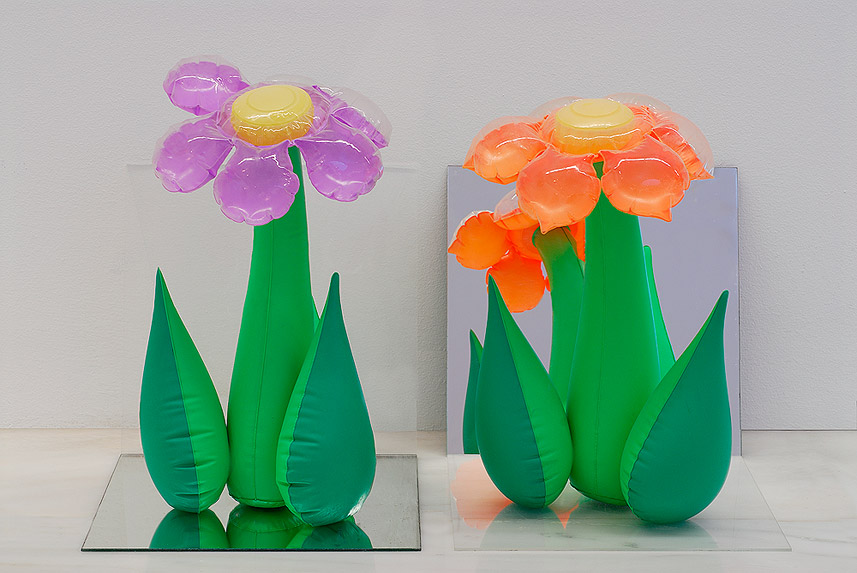

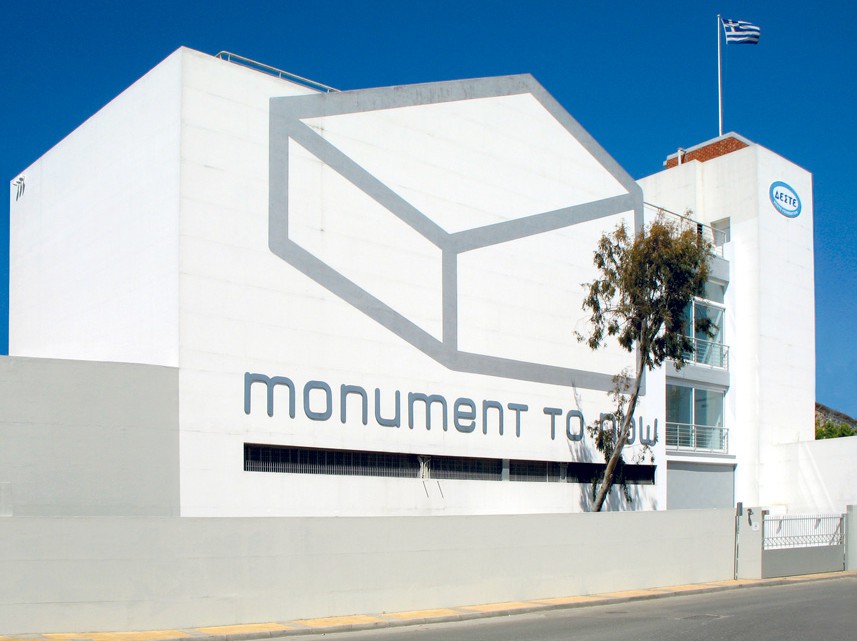
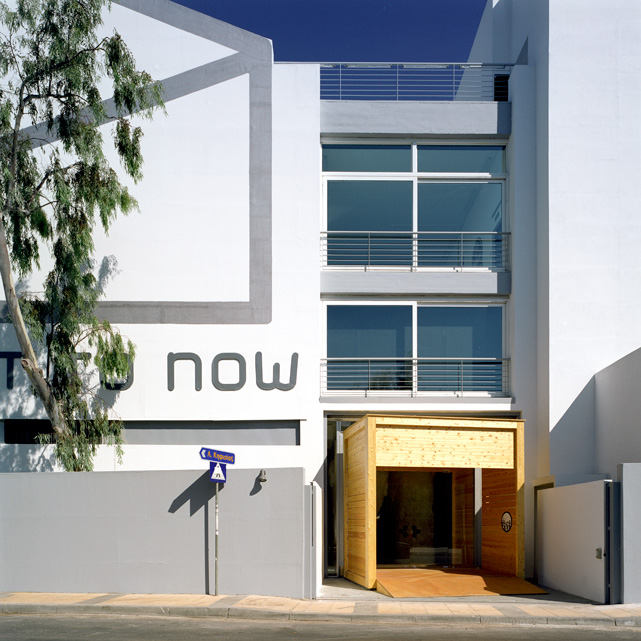
The collection and the exhibitions organized by DESTE did not always coincide, but they complemented each other. The exhibition that was crucial for the development of DESTE was “Cultural Geometry”, in 1988. It took place at the House of Cyprus, where DESTE presented its program from 1988 to 1996, where some of its emblematic and groundbreaking exhibitions took place, such as “Artificial Nature” (1990) or “Post Human” (1992-1993), before acquiring its first permanent space in Neo Psychiko, in 1998, long before the Nea Ionia building, in 2004, or the inauguration of the renovated Old Slaughterhouses in Hydra island and finally the recent collaboration with the Benaki Museum.
“Cultural Geometry” was curated by Jeffrey Deitch and juxtaposed works by (foreign) artists from Joannou’s collection with ceramics from the National Archaeological Museum. The artists would henceforth set the tone for all the exhibitions that would be organized, while at the same time the American graphic designer Dan Friedman would forever change the concept of exhibition catalogues, in essence inventing a visual essay. DESTE was at the forefront of the avant-garde. At the opening of the exhibition, a “well-known, elderly Greek artist” approached Dakis Ioannou. “He said to me: ‘Mr. Ioannou, you have an obligation to support Greek artists as well, not just foreigners.’ I said to him: ‘Excuse me, I imposed on you what you are obliged to do, do you have any obligation towards me? “Let me do what I want to do and please do what you want to do, each one of you doing your own thing,” Dakis Ioannou remembers and laughs. To add: “If you start being guided by the opinions of others, you’re lost. After this incident, I can’t say that I became suspicious of my intentions, at least it didn’t reach me. I think they realized that I don’t give a… of what they are talking about”
The criticism of that local artist was hasty and proved to be unfounded. From the very first exhibition at the Intercontinental, to the projects that took place in the period 1983-1990 and highlighted artists such as “Varotsos, Alitheinos, Totsikas, etc.” to the sporadic exhibitions at the House of Cyprus, to “Anathena,” curated by Marina Fokidis in 2006 in Nea Ionia, or “Part Time Punks,” curated by the Iona brothers, Dakis Joannou supported Greek artists. And then he established the DESTE award, which was instituted in 1999 and is awarded every two years. “Our role is not to promote Greek artists abroad, they mobilize themselves on their own. We give them a platform so that people can see them. That’s all we do, we bring them to the surface. From there, it’s up to them to find a gallery, to work, to develop. I’ve never had the role of “patron”. I don’t like that word, nor do I want that role, because I don’t think like that, nor do I behave like that.”
Dakis Ioannou is accused.
As for the rest, there are quite a few things that have been accused of him. First, that he is like a prisoner of the image, that he chooses works that have no depth beyond their impressive surface.
“Yes, I believe in the image, no matter how much I am accused,” he will admit. “I look for an image that has power, a strong concept and at the same time a sense of humanity and humor, with which you can connect mainly on an emotional level. Do you know what else they say to me? They ask me: “Do you collect masterpieces?” “Wait a minute. I don’t collect masterpieces, these works became masterpieces along the way.” What should I do, to apologize? Ok I apologize.”
Very often people talking negatively about the educational character of DESTE. There is no any. “I never considered it part of my responsibility, I was not interested in taking on the role of education. The mission statement does not include the educational character as it does in museums, because we are not a museum. I wanted the collection to come into contact with the world, I never sought to buy art to keep it for myself and see it alone. DESTE’s mission, however, is the dialogue between contemporary art and contemporary culture. From there on, you let things take their course.” The criticism was also harsh for the exhibition “Skin Fruit,” which was held in 2010 at the New Museum and curated by Jeff Koons. “Because I was on the board of trustees of the museum, because the collection was mine, and because it was curated by my best friend, who also had his works in the collection. The journalist from the “New York Times” called me to talk and I was trying to explain to her that DESTE predated the collection and that this is how we always operated. She listened, listened, had me on the phone for like an hour, and didn’t write anything down in the end. Only what I said at the end, after a question from her: “Listen, I know who I am and I know what I am doing.”
Dakis Joannou knows and truly believes in the spontaneous, unpredictable planning of DESTE’s activities, “what remains constant is the relationship with the artists,” as he says. “The way I deal with art, I am not interested in the market. I don’t go to art fairs or galleries. I only go to studios to meet the artists. The market is always through the gallery, it is an unbreakable rule, because I do not accept having a financial relationship with the artists. That is why, although art has acquired a huge geographical scope, I only go as far as my hands can reach. “If there’s a good Chinese artist for instance, there is a good Chinese artist. If I don’t get to know him and if I don’t get some kind of relationship with him, I can’t move forward.” Is such a relationship equal? Doesn’t the relationship between collector and artist have an authoritarian character?” I will ask. “No, it is equal. We are friends with the artists, our conversations are always friendly. I have never fallen out with people and the prospect of relationships that are created. It is not instinct, it is chemistry and it is evident from the beginning.” The friendship whith the creatives extends, of course, to the curators. Massimiliano Gioni, the curator of the upcoming exhibition “The Equilibrists” – is collaborating with DESTE for the fifth time, from the exhibition “Yesterday Begins Tomorrow” (2003) to “Alpha Omega” which he curated in 2010 together with Joannou. But does he have the same good relationship with other collectors in Greece or abroad? “Of course, both here and abroad. What Dimitris (ed.: Daskalopoulos) did, for example, with Abramovic was a tremendous exhibition. I went, I didn’t do the Method, I didn’t feel like it, but I saw the work of the rest Greek artists and I really liked it. The project “As One” worked amazingly. I’ve known Marina since the 80s.” “They accuse her of commercializing her art,” I will object. “So? What happened? The artist must communicate. He must have a gallery and his works must be sold, for people to see. If you don’t communicate your art, what kind of artist are you?”
“The Equilibrists”: Benaki Museum, Pireos Street building, 17/06-09/10 2016
* Published in BHmagazino on Sunday, June 5, 2016
Text by Marilena Astrapellou
Translation: Panagiotis Margaritis
Photography: Andreas Simopoulos, Charalampos Louizides, Katerina Glinou © Deste Foundation


